
Agriculture faces growing pressures worldwide. Rising production costs, limited water, changing weather and fluctuating market prices are encouraging farms to explore different cropping systems. There is also increasing interest in specialist crops that could create greater value on a limited area of land.
One approach attracting attention is saffron intercropping: growing saffron alongside other crops within an integrated system. Research projects in the United States are examining whether saffron can fit into existing vegetable and chile production, and what this might mean for farm income and resource use.
What does saffron intercropping mean?
Intercropping means growing different crops on the same area of land. Its aims can include using resources more efficiently, supporting soil quality and spreading financial risk.
For saffron, the opportunity lies partly in its distinctive growing cycle. Many vegetables grow actively in spring and summer, whereas saffron flowers mainly in autumn. Its growth and dormancy do not follow the same timetable as many summer crops.
These different seasonal rhythms create opportunities to explore how the same land might support complementary crops. They do not, by themselves, establish that every combination will work.
Why researchers are studying saffron intercropping
A research project at New Mexico State University is investigating whether saffron can be grown alongside chile.
The underlying idea is straightforward: chile plants carry out much of their active growth during spring and summer, while saffron’s important flowering period comes in autumn. Combining the crops could allow farmers to use the same area at different points in the season and increase its productive value.
Researchers are also interested in possible effects on soil structure, biodiversity and sustainability. The investigations are ongoing, but the project illustrates saffron’s developing role in agricultural research: it is being considered as part of an integrated farming system, as well as a specialist spice crop.
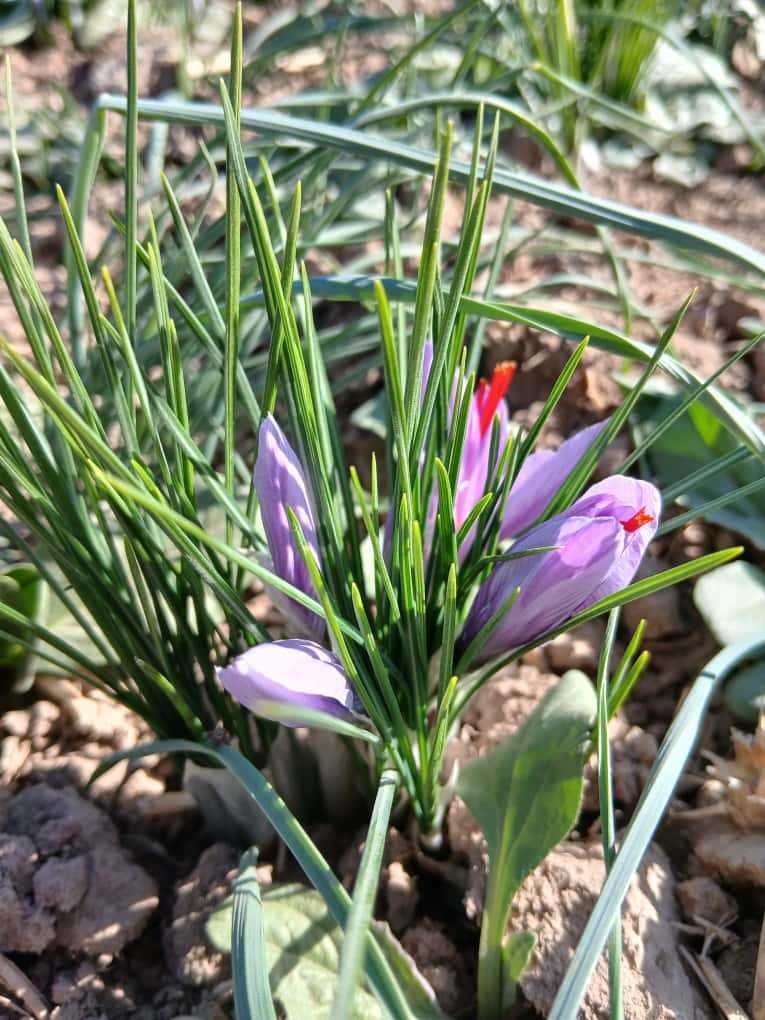
Saffron and chile: another way to use farmland
The pairing may seem unusual at first. Its rationale becomes clearer when the seasonal cycles are considered. In many regions, saffron is harvested in October and November, when chile production is approaching its end.
This may create a window for using land more effectively. Where available farmland is limited, complementary crops could increase the potential value produced per hectare.
The New Mexico researchers are therefore exploring whether saffron intercropping might open additional income opportunities without requiring more land.
What benefits could saffron intercropping offer?
More efficient land use
The most immediate possibility is making greater use of existing growing space. This could be particularly relevant to smaller farms seeking an additional source of income.
Spreading risk
A farm dependent on one crop is exposed when weather or market conditions reduce its returns. Diversifying crops may reduce that dependence, although the resulting stability still needs to be evaluated.
Potential sustainability benefits
Different crops interact with soil structure and nutrient availability in different ways. Compatible systems may offer opportunities to support longer-term soil fertility. Such benefits depend on the crops and their management.
New market opportunities
Saffron is a high-value spice, so even a small harvest can have commercial value. That makes it interesting as a possible addition to an existing crop system. A high selling price, however, is only one part of the calculation.
Can intercropping make a farm more profitable?
This is a central question for the research. Saffron often commands a much higher price than conventional field crops, but production is labour-intensive. Flowers are harvested by hand and the stigmas must be carefully separated.
Profitability must therefore be judged by the relationship between production costs, labour and the price a farm can actually obtain. The spice’s market value cannot be considered in isolation.
The New Mexico researchers stress that further work is needed to assess economic viability. Initial cultivation results suggest that saffron can grow under the region’s conditions, but that does not establish the profitability of every combined system.
For farms with the necessary labour, adding saffron could be a useful opportunity to investigate. For a wider comparison, see our article on international evidence and farming trade-offs.
Saffron intercropping and climate adaptation
Changing water availability, temperatures and extreme weather make production planning more difficult for many traditional crops. Farmers are exploring crops and management systems that could broaden their options.
Saffron is being studied in several regions as a potential alternative or complement to existing crops. Intercropping fits this wider search for flexible systems that can spread economic and environmental risks.
Whether it proves useful in practice depends on regional growing conditions, labour costs and market demand. Our article on saffron and climate change considers the wider cultivation context.
What questions remain?
Researchers and growers still need evidence on long-term yields, soil quality and the most suitable crop combinations for different climates. The substantial labour required at harvest remains an important consideration, particularly where wages are high.
Economic results should also be observed over several seasons before firm conclusions are drawn. A successful trial is encouraging, but broader recommendations require more than one harvest.
Does saffron intercropping have a future?
The approach shows how a traditional crop might fit into modern farming systems. Research suggests that saffron deserves attention both as a specialist crop and as a possible component of a mixed cropping system.
Climate pressures, limited land and rising costs make these questions relevant. The coming years will show where the approach is practical and commercially viable. For now, the research offers useful directions for investigation rather than a universal farming solution.