
Saffron and climate change: an agronomic challenge
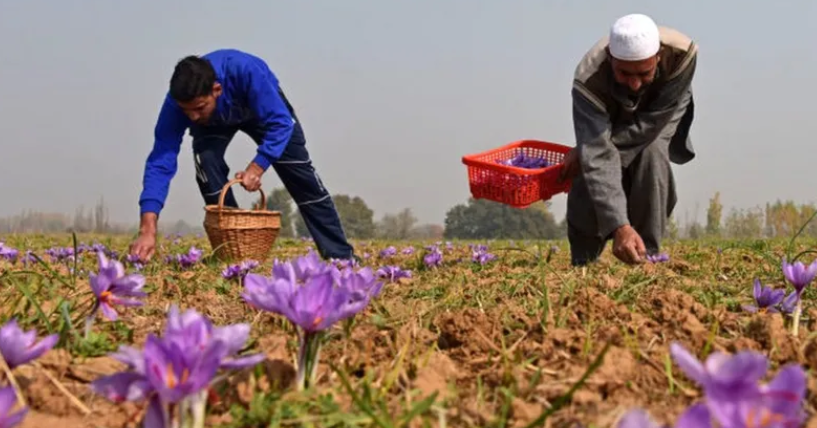
The relationship between saffron cultivation and climate change is more than a theoretical question. In traditional growing regions, including Kashmir, Iran and parts of the Mediterranean, weather-related fluctuations can affect production. Heavy rain during flowering, prolonged dry periods and unusual temperature patterns can influence flower development and the harvest of stigmas.
Reports of production fluctuations in Jammu and Kashmir illustrate the vulnerability of the crop. However, the size of a reported decline depends on the season, location and comparison year. Weather impacts should be assessed using clearly identified data rather than a single percentage presented as a general rule.
Why saffron is sensitive to changes in seasonal conditions
Saffron (Crocus sativus L.) has a distinctive growth cycle. Its short autumn flowering period is particularly important: the number of flowers and harvestable stigmas is determined within a limited window.
Research on saffron under climatic stress highlights the importance of seasonal temperature patterns. Changes in late summer and early autumn can influence the physiological processes involved in flower development.
Gradual changes in seasonal conditions matter alongside extreme weather events.
Drought and saffron cultivation
Water stress has different effects depending on its timing and severity. Saffron tolerates seasonal dryness, but prolonged drought during active growth can affect daughter-corm development and subsequent production.
Experiments suggest that water stress during critical growth phases can reduce flowering. Combined stresses, such as limited water and high temperatures, require particular attention.
A dry period is therefore not automatically harmful. The growth stage, soil moisture and other stress factors determine its significance.
Heavy rain during flowering
Although drought often receives more attention, heavy rain during flowering may also create problems. Rain at a sensitive time can:
- damage flowers,
- create conditions favourable to fungal disease,
- make harvesting and preserving stigma quality more difficult.
Saffron is sensitive to waterlogging. Corms in poorly drained soil are vulnerable to rot.
The challenge is therefore not simply insufficient water, but also excess water at the wrong time.
Temperature stress and flower development
Temperature is central to saffron development. Controlled studies show that the sequence of warmer and cooler conditions affects sprouting and flowering. This does not mean that a single temperature is optimal for every stage or cultivation system.
A controlled-environment study published in 2024 examined corm germination and flowering at different temperatures. It found that a warmer germination phase followed by cooler flowering conditions performed better within the treatments tested. These experimental findings should be interpreted in the context of the growing conditions and planting material used.
Seasonal temperature patterns, rather than annual average temperature alone, are therefore important for assessing climate-related risks.
Interactions between soil, water and climate
Climate effects interact with soil properties and irrigation management. Water shortages can increase reliance on irrigation, while unsuitable water quality or inadequate drainage can contribute to salt accumulation.
Saffron responses to salinity depend on the level of stress and the cultivation system. Adaptation therefore requires attention to water quality, drainage and irrigation timing as well as rainfall.
Jammu and Kashmir: infrastructure and weather risks
The example of Jammu and Kashmir shows why investment in planting material and irrigation infrastructure must be considered alongside weather-related risks. Improvements in cultivation cannot eliminate the crop’s exposure to unfavourable seasonal conditions.
Assessing local production requires both agronomic information and reliable time-series data. A poor harvest in an individual season does not by itself quantify the contribution of long-term climate change.
Adaptation options for saffron growers
Potential approaches discussed in cultivation research include:
- improving drainage,
- maintaining suitable soil structure,
- selecting appropriate sites,
- adjusting irrigation timing to crop development and soil moisture.
Controlled substrate or indoor systems may protect particular growth stages, but also introduce costs, energy requirements and management constraints. Their suitability needs to be evaluated for the intended production cycle.
No single intervention can remove every risk associated with extreme or variable weather.
Limits of the current evidence
Although studies document saffron responses to temperature and water stress, important uncertainties remain:
- differences between local microclimates,
- the availability of comparable long-term production data,
- interactions with soil conditions, corm size and planting material,
- the extent to which controlled experiments reflect field conditions.
Research on saffron and climate change therefore requires continued data collection and cooperation across disciplines.
Conclusion: a long-term challenge for research and practice
Saffron production can be affected by drought, excess rainfall and temperature stress, particularly when these conditions coincide with sensitive growth stages. The consequences depend on timing, severity and local cultivation conditions.
Suitable sites, drainage and careful water management may reduce some risks. They cannot guarantee stable harvests under every future weather pattern.
The Saffrona Academy approaches climate questions through evidence and explicit limitations. Explore further articles on sustainable cultivation in the Saffron Academy.
Selected scientific sources
Husaini, A. M., et al. Challenges of climate change: Omics-based biology of saffron.
Anuar, N., Mat Taha, R., Abdullah, S., Nazira, M., and Abdumutalovna, M. S. (2024). Temperature effects on corm germination and flowering of Crocus sativus L. (saffron). Journal of Animal & Plant Sciences, 34(1), 130–137. DOI: 10.36899/JAPS.2024.1.0701131.