
Saffron drought tolerance is the focus of a 2025 study in Scientific Reports. Researchers examined the role of fibrous roots in the response of Crocus sativus to simulated drought and the effects of penconazole pretreatment.
Key findings
- Roots and leaves responded differently: fibrous roots had lower hydrogen peroxide (H₂O₂) and malondialdehyde (MDA) levels than leaves. Root peroxidase (POX) activity was reported as 600–2,000 times higher.
- Antioxidant responses: pretreatment with 15–25 mg/L penconazole increased root superoxide dismutase (SOD) and catalase (CAT) activity, with reported increases up to 275% and 189%, respectively. It also reduced lipid-peroxidation markers and altered proline levels.
- Leaf pigments: under simulated drought, penconazole increased carotenoid levels and the chlorophyll-a/chlorophyll-b ratio.
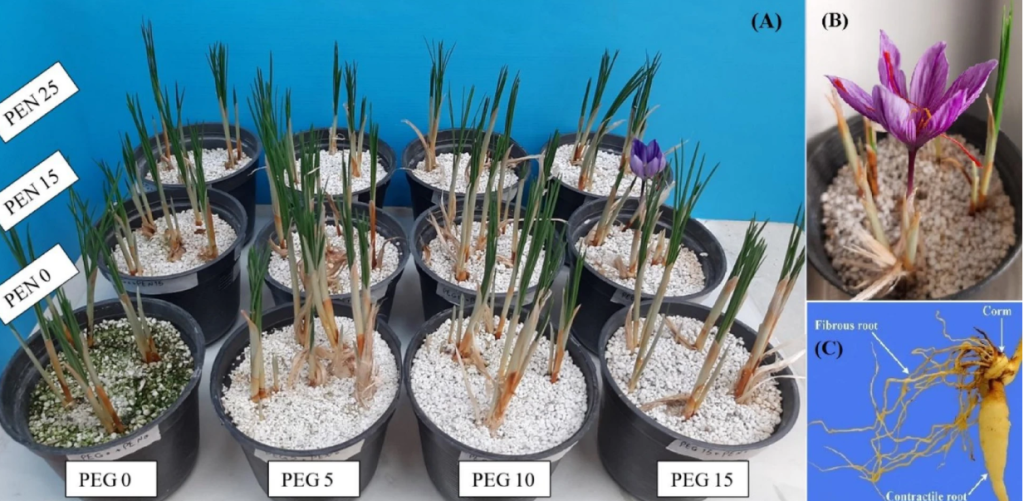
- Growth measurements: PEG-induced stress affected leaves, roots and corms. Some growth measurements, including corm dry weight, improved under particular treatments.
What does this mean for practice and research?
The study highlights fibrous roots as an important part of saffron’s stress response. It provides a reason to investigate root health and antioxidant defence more closely.
The chemical pretreatment results require separate field validation. Concentrations used in an experiment are not instructions for growers, and physiological markers are not the same as demonstrated improvements in commercial harvests.
Water management, drainage, soil condition and locally appropriate agronomic advice remain important. The experiment does not establish a general irrigation or fertiliser programme.
How was the experiment conducted?
The researchers used controlled experiments with polyethylene glycol (PEG) to induce water stress at 0–15% and compared physiological and growth responses after penconazole pretreatment.
The results suggest that stronger antioxidant activity in fibrous roots can help limit oxidative damage under these conditions. How well this transfers to ordinary field drought remains a research question.