
A 2025 study examined how reduced light affects saffron’s underground storage organs. Its important result concerns corm yield, rather than a measured reduction in the weight of harvested saffron spice.
Two field seasons in Sichuan, China · Natural light versus 50% natural-light intensity · Corm development and carbohydrate metabolism · Results should be interpreted within the experimental conditions.
What the researchers compared
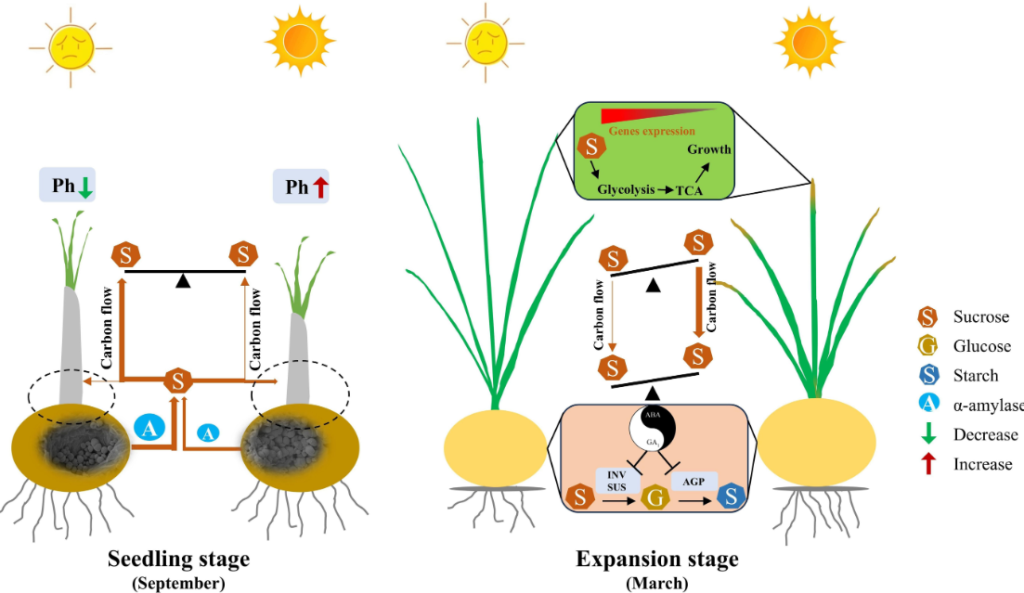
Yang and colleagues compared natural light with shading to 50% of natural-light intensity over two field seasons. They assessed plant form, photosynthesis, carbohydrates, enzyme activity and hormone-related responses.
Low light and corm development
Corm yield was lower by 23.66% in 2023 and 21.23% in 2024 under the low-light treatment. Leaves were larger and longer, while the pattern of carbohydrate allocation and starch formation in the underground organs changed.
The researchers reported higher gibberellin and auxin levels and lower abscisic acid under reduced light, alongside changes in starch-related enzymes and gene expression. They interpret the findings as a shift toward leaf growth that limits daughter-corm development.
What this means for growers
Plant height or leaf length alone is not a complete indicator of productive development. A cultivation assessment should record the organs and outcomes that matter to the crop, rather than equating a taller plant with a better harvest.
The result also highlights a distinction between a corm crop and the dried stigma crop. They are related parts of saffron production, but a percentage reported for one should not be relabelled as a measured result for the other.
Questions for greenhouse and indoor systems
- Light measurement: What intensity and daily exposure reach the plants?
- Crop stage: Is the system designed for flowering, vegetative development or corm renewal?
- Other conditions: How do temperature, water and planting material interact with the lighting plan?
- Output: Are corm size, corm number, flowers and dried stigma yield measured separately?
- Resources: Does any improvement justify its energy and operating costs?
This study is not a universal lighting recipe. A relative treatment such as 50% natural light depends on its location and season, and cannot be converted directly into one lamp setting for every farm.
Hormone measurements help investigate mechanisms. They should not be taken as a recommendation to apply growth regulators without a suitable agronomic protocol.
Frequently asked questions
Did the study prove a 23% drop in saffron spice yield?
The headline outcome reported here is corm yield. It should be described accurately rather than restated as a direct spice-harvest result.
Does more light always produce better results?
The experiment compares two specified conditions. It does not establish that continually increasing light is optimal or economical.
Primary source
Yang, W. et al. (2025). Low light reduces saffron corm yield by inhibiting starch synthesis. Frontiers in Plant Science, 16. Read the open-access study.
Explore cultivation research in the Saffron Academy or discover Saffrona’s culinary saffron.