
Saffron intercropping as an agronomic research topic
Saffron intercropping belongs to an established field of agricultural research. Two or more crops share the same area, with growing seasons that overlap at least partly. The aim is not necessarily to maximise the yield of one crop, but to improve land-use efficiency, resource use and the ecological stability of the overall system.
Researchers often use the land equivalent ratio (LER) to evaluate such systems. A value above 1 indicates that the intercropping system uses land more efficiently than separate monocultures.
For saffron, this raises a nuanced question: does intercropping increase saffron yield, or does it improve the resilience and performance of the wider farming system?
Intercropping with chickpea: weed dynamics and resource competition
A 2023 open-access study in PLOS ONE examined saffron–chickpea intercropping under two irrigation regimes in a semi-arid environment.
- Intercropping reduced weed density and biomass compared with the monocultures studied.
- Irrigation management interacted with the planting ratio.
- The 1:1 and 2:2 saffron–chickpea combinations with one-time irrigation were particularly promising for weed management.
The findings concern weed suppression under the specific trial conditions. They should not be treated as proof that chickpea increases saffron yield in every environment.
This example shows how intercropping may address an agronomic problem without making increased saffron production the only measure of success.
Saffron and soil biology: intercropping with grapevines
A 2024 study in BMC Microbiology compared saffron–grape intercropping with saffron monoculture.
- The intercropping treatment had more saffron flowers.
- Rhizosphere microbial communities differed between the systems.
- Soil pH also changed.
These findings suggest links between the cropping system, soil microorganisms and saffron flowering. Correlations do not by themselves establish which microorganisms caused the observed changes.
The results are specific to the systems and conditions tested; they do not guarantee equivalent benefits at other sites.
Intercropping with winter wheat: yield and environmental trade-offs
Two related papers examine saffron–winter wheat systems from different perspectives: a 2022 yield study in the International Journal of Plant Production and a 2023 study of nitrogen leaching in Scientific Reports.
These outcomes must be distinguished:
- Saffron yield alone is different from the combined productivity or income of saffron and wheat.
- The yield study reported advantages for the combined system under its trial conditions.
- The environmental study examined drainage and nitrogen losses across different irrigation and fertiliser treatments.
The practical lesson is to evaluate the entire cropping system. A change in saffron yield alone cannot capture all economic or environmental effects.
Saffron in olive groves: Mediterranean diversification
Research in rainfed olive groves has examined saffron as an alley crop alongside other diversification options. A 2023 paper in the Journal of Environmental Management investigated changes in soil bacterial communities and microbial capacities.
The saffron treatment combined with spontaneous vegetation cover was associated with changes in soil microbial communities and increased soil carbon and nitrogen. These findings concern a particular management system, rather than an automatic benefit of planting saffron between any olive trees.
Here, diversification and soil function are relevant goals alongside crop production. Any additional income also depends on local yields, labour and market conditions.
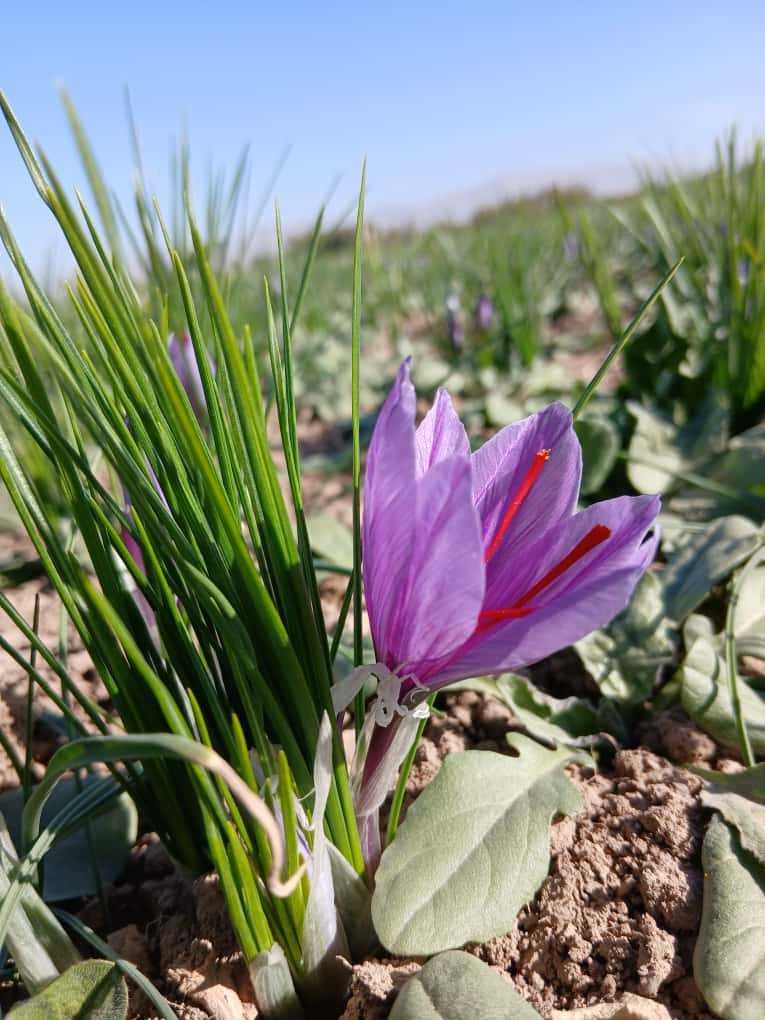
Saffron intercropping in the United States: New Mexico State University
A New Mexico State University research project explores integrating saffron with other New Mexico crops, including chile production systems.
Seasonal complementarity is an important research question: can crops with different growth cycles make more effective use of the same land?
This project adds a North American context to saffron diversification research. Project reports and preliminary observations should be distinguished from replicated, long-term evidence or guaranteed commercial yields.
Factors that shape saffron intercropping outcomes
Studies suggest that outcomes depend on several interacting variables:
- water availability and irrigation management,
- competition for nutrients,
- planting density and row spacing,
- soil type and drainage,
- local climate and the timing of each crop’s growth.
Intercropping can have positive or negative effects on saffron production. The companion crop, trial design and site conditions determine whether complementarity or competition dominates.
Limits of the evidence
The evidence does not support a universal prescription. Important questions include:
- whether results persist over many years,
- how outcomes vary with regional microclimates,
- the influence of corm size and planting material,
- the profitability of the complete system, including labour and management costs.
Scientific assessment of saffron intercropping must therefore remain context-specific.
Conclusion: evaluating the whole farming system
The studies discussed here suggest that saffron intercropping may:
- reduce weed pressure in particular combinations,
- change soil microbial communities,
- affect nutrient losses and other environmental indicators,
- alter saffron yield and the combined productivity of the system.
Intercropping is a site-specific farming option rather than a universal route to success.
The Saffrona Academy assesses these systems through evidence, practical trade-offs and study limitations. Promising results need to be tested against the conditions in which growers intend to use them.
Explore further analyses of sustainable saffron production in the Saffron Academy.
Scientific sources
Mohammadkhani, F., et al. (2023). Weed community changes in saffron+chickpea intercropping under different irrigation management. PLOS ONE, 18(5), e0286474.
Tao, Y., Zhou, G., Zhang, X., et al. (2024). Effects of saffron-grape intercropping on saffron flower number and rhizosphere microbial community. BMC Microbiology, 24, 551.
Abbasi, M. R., and Sepaskhah, A. R. (2022). Evaluation of Saffron Yield Affected by Intercropping with Winter Wheat, Soil Fertilizers and Irrigation Regimes in a Semi-arid Region. International Journal of Plant Production, 16, 511–529.
Nitrogen leaching and groundwater N contamination risk in saffron/wheat intercropping under different irrigation and soil fertilizers regimes. Scientific Reports (2023).
How binomial (traditional rainfed olive grove-Crocus sativus) crops impact the soil bacterial community and enhance microbial capacities. Journal of Environmental Management, 345 (2023), 118572.
New Mexico State University. NMSU research project explores intercropping of saffron, other NM crops. University research news; distinct from a peer-reviewed journal article.