
Saffron and cholesterol may initially seem unrelated. Saffron is best known as a spice, while cholesterol is closely associated with cardiovascular health. Scientific interest in saffron has nevertheless expanded beyond its culinary and cultural roles to examine its bioactive plant compounds.
Researchers are investigating whether saffron influences biological processes involved in cholesterol metabolism. The question is more specific than a simple claim that “saffron lowers cholesterol”: it concerns molecular mechanisms that could inform further research.
Cholesterol in modern health research
Cholesterol serves essential functions in the body. Problems can develop when excess cholesterol accumulates in blood-vessel walls and contributes to atherosclerosis, a process involved in heart attacks and strokes.
Research therefore considers cholesterol as part of a complex system of transport pathways, receptors and regulatory genes. One important process is reverse cholesterol transport (RCT): moving excess cholesterol from tissues back to the liver for processing or elimination.
This is the pathway explored by the saffron study discussed below.
What is reverse cholesterol transport?
RCT is part of the body’s protective machinery for managing cholesterol accumulation. Several proteins and genes contribute:
- SR-BI participates in the liver’s uptake of HDL cholesterol.
- ABCA1 supports cholesterol movement out of cells.
- PPARγ is a regulatory factor involved in lipid metabolism and inflammatory processes.
Disruption of these pathways can impair cholesterol removal and contribute to vascular disease. Researchers are studying whether plant-derived substances can modulate these processes.
Saffron and cholesterol: findings from preclinical research
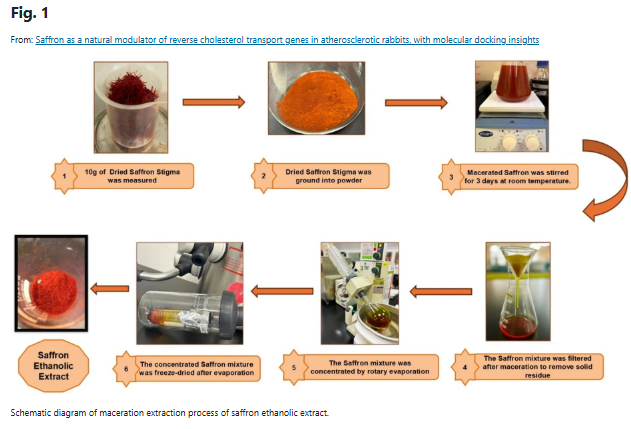
A study in Scientific Reports examined how saffron extract affected the expression of RCT-related genes in rabbits with experimentally induced atherosclerosis.
Saffron treatment increased expression of SR-BI, which is involved in HDL-mediated cholesterol transport. ABCA1 and PPARγ expression also tended to increase, but those changes were not statistically significant.
The distinction matters: these are molecular findings in an animal model, not evidence of clinical treatment effects in humans. They offer clues about possible biological mechanisms and questions for further experiments.
What role might saffron’s compounds play?
Saffron contains bioactive compounds including crocin, crocetin, safranal and quercetin. Their antioxidant and inflammation-related activity is of interest in experimental research.
The study also used molecular docking: computer modelling that estimates how compounds might interact with target proteins.
The simulations suggested favourable binding of crocetin and quercetin to targets involved in cholesterol transport. Such predictions do not replace biological experiments. They help researchers select plausible mechanisms to investigate.
Why a higher amount is not automatically better
The findings indicate that responses depend on the dose and experimental context. In some settings, lower doses produced comparable or more favourable effects than higher doses.
Biological responses to plant compounds can be complex and need not increase in a straight line with dose. This study does not provide a human dosing recommendation.
For interpreting saffron and cholesterol research, simple cause-and-effect claims would therefore be inappropriate.
What this research can—and cannot—show
The results contribute to understanding saffron’s biological activity, with clear boundaries:
- This is preclinical research.
- The experimental findings come from an animal model.
- The study does not directly establish effectiveness in humans.
This type of research is useful for identifying potential relationships and developing further studies. Human clinical research is needed before a treatment conclusion can be drawn.
Saffron within the wider picture of health
The Saffron Academy approaches saffron as a subject for careful research, rather than a miracle remedy. Diet, physical activity, genetic factors and lifestyle belong to the wider context of cholesterol management.
Research on traditional plant products has a place in modern science. That place requires sound methods and careful interpretation; saffron should not be presented as a replacement for prescribed medical treatment.
Our guides to saffron tolerability and culinary amounts and extracts explain why findings for a study preparation cannot simply be transferred to every saffron product.
Limitations and open questions
The authors identify limitations including small group sizes, the absence of protein and functional analyses, and the need for longer-term studies and human research.
Gene expression is only one level of biological evidence. A change in a gene’s activity does not, by itself, show improved cholesterol removal or a health benefit in people.
Acknowledging these limits is part of responsible scientific communication. The evidence develops through further testing, especially in nutrition and health research.
What can we say about saffron and cholesterol today?
- There are biologically plausible questions linking saffron compounds and cholesterol transport.
- The study reports modulation of selected transport-related genes in rabbits.
- Its findings are preclinical.
- Clinical conclusions cannot be drawn from this study alone.
The Academy’s role is to make this research understandable and accessible while keeping the strength of the evidence clear.